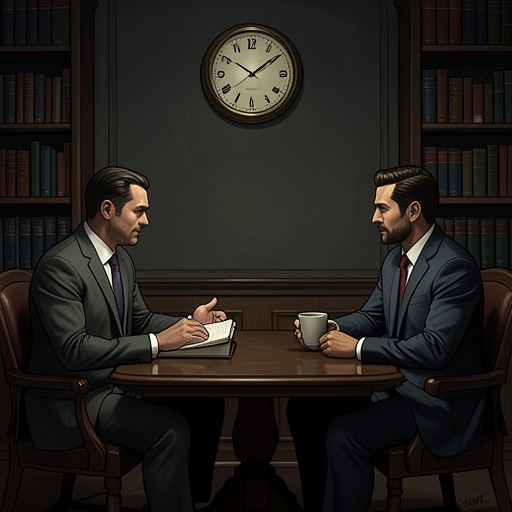
Alex Delaware–Milo Sturgis partnership
Dr. DeathThe Alex Delaware–Milo Sturgis partnership is an investigative alliance in which psychological insight and police work meet through frequent exchanges of information and judgment. Alex accompanies Milo through the investigation of Eldon Mate’s murder, helping him weigh evidence without simply endorsing every theory. Their collaboration is marked by candor: each can voice uncertainty, and the investigation advances through what they share as well as what they question.
Sharing Leads and Uncertainty
After speaking with a man who knew a lawyer associated with the case, Milo remarks that Mrs. Mate and an ordinary street informant seem to have worked things out before he has. The remark conveys the strain of an investigation in which suggestive details arrive from different directions without yet forming a dependable account. Alex’s observation about a lawyer who drives a van keeps the exchange close to a concrete lead, while Milo turns it into a dark possibility involving one killer representing another.
Their information-sharing also extends to developments outside the immediate conversation. When Milo receives a call from Petra Connor with new information about Donny, Alex is with him; Milo tells him what she has learned and arranges to meet her. The episode shows the partnership functioning as an ongoing exchange: news gathered elsewhere becomes part of the inquiry they are pursuing together.
Trust and Professional Judgment
When Leimert Fusco contacts Alex, Alex tells Milo about the call and explains that he did not want to speak with Fusco before clearing it with his partner. That choice indicates trust, but also recognizes that contact with federal investigators could affect Milo’s case. Alex says he has nothing to add, yet makes the disclosure itself part of their working relationship rather than handling the approach privately.
Their agreement does not mean that they reach the same conclusions automatically. Looking at the painting associated with the case, Milo sees evidence of both rage toward Mate and ambivalence about him; Alex offers no further interpretation. Later, Milo weighs whether Michael Burke should be treated as a suspect. He acknowledges similarities between Burke and the killer, but stresses that the pattern is far from a perfect match: Mate was not a young girl and was not tied to a tree. For Milo, those differences matter more than a broad resemblance between violent offenders.
The Investigation’s Limits
Milo resists allowing suspicion of Burke to pull the inquiry away from leads closer to home. Pursuing Burke, he argues, could mean chasing a fugitive whom the Federal Bureau of Investigation has failed to apprehend for three years, while the case already offers nearer prospects. He is also conscious that refusing to cooperate with Fusco could bring pressure from higher authorities and entangle him in a task force. His preference for dealing with Fusco as one police officer to another is therefore both practical and provisional.
The partnership’s value lies in keeping these alternatives visible: a suggestive resemblance is considered, tested against differences, and set beside the costs of widening the search. Alex’s presence gives Milo a trusted interlocutor as he sorts through the leads, while Milo’s procedural concerns keep the discussion grounded in the demands of an active investigation. Their collaboration does not resolve uncertainty at once; it makes uncertainty something they can examine together.